

Two quotes arrive for what looks like the same job. One is $1,200 a month and the other is $2,000. The service descriptions are nearly identical, so the cheaper one seems like the obvious choice.
Then you read the fine print. The first quote covers transaction coding only. The second includes reconciliations, a month-end close, financial statements, and a review call. They were never the same service.
This is the most common trap in accounting outsourcing services. The label is the same, while the scope varies widely. This guide shows what a complete engagement includes, what usually costs extra, and the questions that reveal the difference before you sign.
The Three Layers of Outsourced Accounting
Accounting is not a single task. Providers package it in layers, and knowing the layers makes any proposal easier to read.
Layer 1: Bookkeeping. Recording transactions, coding them to the right accounts, and reconciling bank and card statements.
Layer 2: Accounting. Closing the month, preparing financial statements, managing payables and receivables, and coordinating with your tax preparer.
Layer 3: Advisory. Budgets, cash forecasts, KPI reporting, and guidance on decisions such as hiring or pricing.
Many outsourced accounting services combine the first two layers and offer the third as an option. A proposal that covers only Layer 1 is a bookkeeping engagement, even if the page is titled “accounting.”
What Is Usually Included
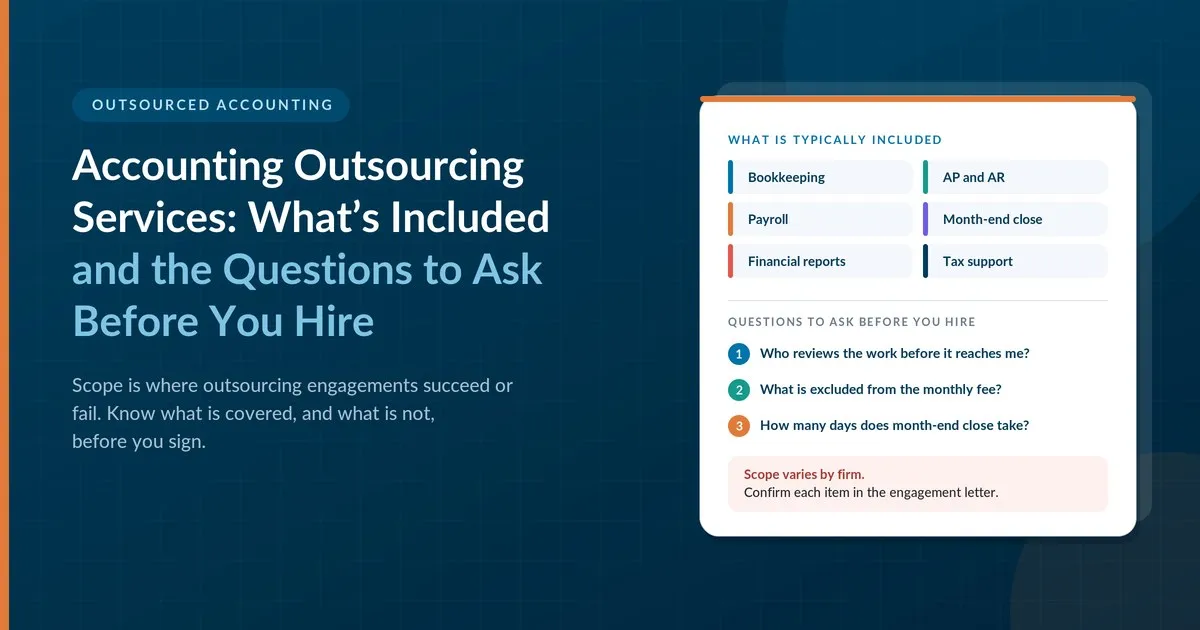
A complete package has a clear core. Check that each of these appears in writing.
| Service | What it should mean in practice |
|---|---|
| Transaction coding | Bank and card activity is categorized consistently |
| Bank and card reconciliation | Every account is matched to its statement each month |
| Accounts payable | Bills are entered, scheduled, and paid on approval |
| Accounts receivable | Invoices are sent and followed up on a set schedule |
| Month-end close | The books are reviewed and locked by an agreed date |
| Financial statements | A profit and loss report, balance sheet, and cash summary each month |
| Support for tax filings | Clean records are delivered to your tax preparer |
If any item is missing from a proposal, ask whether it is excluded or simply left out of the summary.
What Often Costs Extra
Add-ons are not a problem. Surprise add-ons are. Ask about each of these before you compare prices.
- Catch-up or cleanup work. Fixing past months is a separate project from the monthly service.
- Additional entities or locations. Each set of books may be billed on its own.
- Payroll processing. Running payroll is different from recording it.
- Sales tax filing. Tracking sales tax and filing returns are separate tasks.
- Inventory or job costing. Industry-specific tracking often requires extra setup.
- Advisory and forecasting. Budgets and cash forecasts may sit in a higher tier.
- Tax return preparation. Many providers coordinate with your preparer but do not prepare returns.
A useful rule is simple. Whatever matters most to your business should be named in the agreement, not assumed.
How Scope Changes the Price
Volume and complexity drive the work, and the work drives the fee. Take a business with 400 transactions a month. If each one takes about two minutes to code and review, that is 400 × 2 = 800 minutes, or roughly 13 hours of work each month, before reconciliation, reporting, or any questions.
Now add a second bank account, a payment processor, and a sales tax review. The hours rise quickly. A fee that looks low for the first case may be unrealistic for the second.
When you compare quotes, ask each provider what volume the price assumes. A fee set for 150 transactions will not stay the same at 600.
Where Payroll Fits
Payroll is the area where scope is most often misunderstood. There are two different jobs:
- Processing payroll. Calculating pay, withholding taxes, and paying employees.
- Accounting for payroll. Recording payroll in your books and reconciling tax deposits to what you owe.
Some providers do both, some do one, and some do neither. Ask which one is in the quote. A solid grounding in how payroll taxes work helps you judge the answer, and this guide to how payroll taxes work for small businesses covers the basics.
For deposit schedules and employer tax rules, the IRS publishes Publication 15, the Employer’s Tax Guide. A good provider can explain how your deposit schedule works and who is responsible for each deadline.
Taxes: Coordination vs Preparation
Owners often assume that outsourced accounting includes tax filing. It may not.
Tax coordination means your accountant keeps your books clean, answers your preparer’s questions, and delivers a year-end package. Tax preparation means someone actually prepares and files your returns. Both can come from one provider, but they are usually priced separately.
Ask which is included, and ask who signs the return. If a separate preparer handles it, ask how information is shared between the two teams.
Technology and Access
A professional provider works in software you own. Confirm these points:
- You own the accounting file and hold the master login.
- The provider has user access, which you can remove at any time.
- Bills and receipts move through a shared tool, not email threads.
- Reports are delivered on a fixed date, in a consistent format.
Ask which platforms the provider supports, such as QuickBooks Online, Xero, or Gusto. Moving platforms during an engagement adds cost and risk.
What a Typical Onboarding Looks Like
A well-run start takes several weeks. Expect something like this:
- Week 1. Access is granted, the provider reviews your chart of accounts, and open items are listed.
- Weeks 2 to 4. Past months are reconciled and corrected. Unusual items are flagged for your input.
- Weeks 4 to 6. The first monthly close is completed, and reports are reviewed together.
- Month 3. Scope and routines are adjusted based on what you have seen.
A provider with no defined onboarding plan is often still working out its own process.
Questions to Ask Before You Hire
These questions focus on what is included, so use them alongside any general vetting you do.
- Which of these services are in the monthly fee, and which are billed separately?
- What transaction volume does this price assume?
- What do I receive each month, and on what date?
- Is payroll processed, recorded, or both?
- Do you prepare tax returns, or coordinate with my preparer?
- How is cleanup of past months priced?
- What happens if my volume or number of entities grows?
- Who reviews the work before it reaches me?
Ask for the answers in writing. A clear email reply is also a useful sample of how the firm communicates.
Final Thought
The right accounting outsourcing services are not defined by a price or a title. They are defined by what the provider commits to deliver, by when, and for what volume. Read the scope before you read the fee. Put your must-haves in writing, ask about add-ons up front, and run a short trial before you commit. The result is a provider whose work matches what you expected to buy.
This article is for general information only and is not tax or legal advice. Consult a qualified professional about your situation.
About the author: Siddhesh Patel is a compliance and accounting implementation specialist at Datastub, an outsourced accounting and bookkeeping firm serving U.S. contractors, ecommerce sellers, and growing small businesses. Crunch. Strategize. Deliver.