

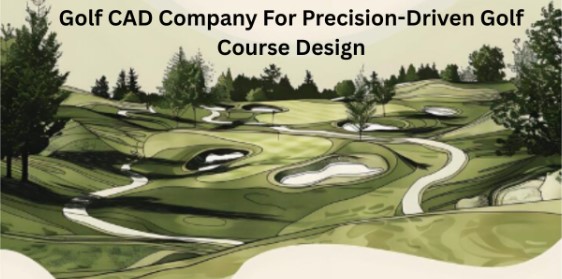
Precision is at the very core of good golf course design. Each contour, alignment of fairway, bunker edge, and green slope has to be computed with precision to ensure playability, constructibility, and long-term performance.
Where creativity and vision are important in giving character to a course, it is actually technical precision that dictates whether a design can be implemented efficiently and maintained sustainably.
This is where the services of a professional golf CAD company come into critical play in supporting precision-driven golf course design through detailed planning, data accuracy, and technical coordination.
CAD is much more than a simple drafting tool in modern golf development; it’s the backbone of informed design and execution.
The Growing Need for Technical Precision in Golf Design
Modern golf course projects are expected to meet high demands: designers are supposed to work within tight land constraints, strict environmental regulations, and budgetary limitations while providing a quality playing experience.
Small inaccuracies at early design stages may result in:
- Expensive grade changes
- Drainage and irrigation problems
- Poor playability or safety issues
The result is that accuracy in the design documentation becomes vital. CAD-based workflows will provide the level of detail and control necessary to manage such complexity.
What a Golf CAD Company Actually Does
A golf CAD specialist brings deep expertise in turning design intent into precise build-ready technical documentation, taking conceptual layouts and providing comprehensive drawings that will help engineers, contractors, and landscape teams.
Typical CAD deliverables are:
- Detailed routing plans
- Grading & Contour Drawing
- Feature layouts for bunkers, greens, and water bodies
- Construction-ready sections and details
These documents ensure that all people involved in a project work with the same accurate information.
Supporting Designers with Technical Accuracy
Golf course designers make use of CAD documentation in order to test and refine their designs. Accurate drawings enable the designers to assess in advance the distances, slopes, and transitions involved before actual construction takes place.
A golf CAD company supports precision in the core phase of design through the creation of correct design idea representations in measurable and scalable formats. It helps architects to focus on strategy and creativity, knowing that technical constraints have been respected.
This will make the shift from concept to execution very smooth.
Improving Coordination between Design and Engineering
The most difficult part of golf course development would be the coordination between designers and engineers. Misalignment of design intention or miscalculation in engineering could lead to delay and rework.
CAD-based documentation bridges the disciplines together. CAD files are used by engineers to:
- Analyzing grading and drainage
- Irrigation and utility systems planning
- Coordinate earthwork quantities
Enables Efficient Construction Planning
Construction is where the design precision really pays off. Contractors need CAD drawings to understand what exactly has to be built, where, and how.
High-quality CAD documentation includes:
- Reduce ambiguity in construction
- Minimize on-site decision-making
- Avoid expensive construction mistakes
Such clear, detailed drawings allow contractors to work more efficiently and reduce the possibility of deviations from design intent.
Supporting Environmental and Regulatory Compliance
Most modern golf course projects have to attain clearances from environmental and planning authorities. For this purpose, such bodies have to go through detailed technical documentation in order to review the impacts and compliance.
CAD drawings help illustrate:
- Accurate grading and land modification plans
- Water management and drainage strategies
- Conservation of protected areas
Precise documentation creates confidence with regulators and allows faster approval processes
Accurately mapping topography, elevation, and surface flow.
CAD Integration with 3D Visualization and Planning
CAD drawings form the technical basis of 3D models, meaning visualizations are based on real design data and not an artist’s interpretation. Such integration thus enables teams to:
- Validating both technical and visual aspects of designs.
- Clearly communicate intent to stakeholders.
- Ensure consistency throughout all project documents.
Most project teams collaborate with an architectural visualization company in India to develop photorealistic presentations straight from your CAD data without losing accuracy.
Supporting Revisions and Design Iteration
Design changes will indeed always occur in every golf course project, and they need to be done because of site constraints, stakeholder feedback, or environmental considerations.
CAD-based workflows make revisions more manageable. Changes can be consistently applied using drawings; this assurance makes updated documentation accurate and coordinated.
This flexibility enables teams to respond to changes without losing control over technical precision.
Long-term Value Beyond Initial Construction
The value of CAD documentation certainly is not limited to construction. Accurate CAD files provide long-term reference for course maintenance, upgrades, and future renovations.
They support:
- Maintenance planning
- Future redesigns or expansions
- Precise recordkeeping by course owners
Therefore, the long-term utility inherent in CAD makes CAD a valuable investment, not merely a one-time deliverable.
Why Specialised Expertise Matters
CAD for golf courses is a specialized discipline. General drafting services do not know about shot distance, green contour, or bunker detailing specific to golf course design.
A specialist provider understands that:
- Golf Design Standards and Conventions
- Coordinating needs with irrigation and drainage
- The importance of precision in playability and safety
This domain knowledge ensures that the documentation truly serves the needs of golf course projects.
Making Sure: Reduced Risk
Every design mistake reaching the construction site increases risk. The right CAD documentation reduces this risk by early identification and communication of possible issues and design intent.
Fewer errors mean:
- Lower construction costs
- Fewer delays
- Better alignment of design and built outcome
- Precision becomes a sort of risk management.
Conclusion
Precision is no longer an option in today’s golf course design. A professional golf CAD company materializes such design intent into accurate, coordinated, and build-ready documentation that will deliver successful golf projects. From early planning and engineering coordination through to construction and long-term maintenance, CAD-driven precision ensures that golf courses are not only well-designed but also efficiently built and sustainably managed.