

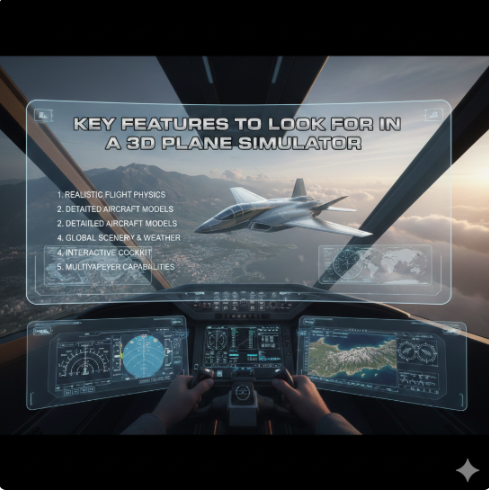
Today, as aviation training and simulation constantly evolve, deciding on a 3D plane simulator has become an important decision for flight academies, commercial airlines, military agencies, and simulation developers. Its visual quality cannot only be a factor, but it also has to emulate flight, help learners focus on their training goals, and work flawlessly with any number of variables.
The right simulator will boost pilot skills, help airlines improve operational safety, and lower the costs of pilot training. There are a handful of basic features that are necessary to deliver that ideal training environment. Know what to look for to identify a simulator that delivers true training value, not just good looks.
True Aircraft Flight Dynamics
The most important aspect is aircraft flight behavior. The underlying simulation must be faithful in modeling lift, gravity, thrust, etc.
Some of what you should look for:
- Proper flight at takeoff, climb, cruise, and landings
- Reality-based stall behavior and recovery techniques
- Expected response to trim, control surface deflections, and control pressures
- Consistent physics for different weights and configurations
Any inaccuracy will promote bad behavioral ‘muscle memory’ in pilots, which then impacts real-world operation. Precise physics simulation cannot be compromised.
Detailed, Operational Cockpit Models
Visual fidelity is not sufficient; cockpits must perform realistically, too. The ideal 3D plane simulator presents an interactive cockpit with instruments, switches, and controls behaving as they would in real life.
Look for:
- Correct instrument panel locations and labels
- Working avionics and instrumentation
- Genuine system feedback and warnings
- Support for IFR and VFR flights
Muscle memory and procedural knowledge come from detailed cockpit models.
Realistic 3D Aircraft Systems Simulation
A robust airplane simulation is not just a flight model. It should go beyond basic flying and accurately simulate all airplane systems.
Key systems include:
- Fuel, engine, and power plants
- Electric systems
- Hydraulics, pneumatics, and associated systems
- Navigation and flight management systems
Pilots need to be able to simulate failures, manage problems, and troubleshoot.
Real-Time Weather Effects
Extreme weather is a major contributor to accidents and safety issues. The weather should be dynamic, affecting both scenery and the aircraft.
Important weather factors:
- Gusts, windshear, and air turbulence
- Rain, snow, fog, and structural icing
- Cloud layers and sea level pressure effects
- Time of day and seasonal variations
Weather influences performance, vision, and pilot workload in the way it would for real.
Immersive, Panoramic Visuals and Terrain
Visual cues are vital for traffic awareness and safety. The ideal simulator‘s graphics include detailed airports, runways, tall structures, and landmarks.
Necessary visual features:
- Detailed runway and taxiway arrangements
- Realistic visual scenery, including distant objects
- Accurate perspective and lighting effects
- Lack of judder or lag
The visual experience is vital for developing spatial awareness in pilots.
Critical Emergency and In-flight Abnormality Simulations
Simulation is most useful when it can prepare pilots for emergencies. The best simulators make it simple for instructors to introduce failures, procedures, or other anomalies.
Must have instructor controls:
- Engine failure, partial power, or stall
- Sensor and instrument failures
- Unexpected electrical or hydraulic issues
- Environmental phenomena such as wind shear
The operator should be able to repeat crisis scenarios to increase pilots’ confidence.
Specific training modes:
- Training scenarios that can be altered for every individual
- Learning tasks of all ranks, from passenger to pilot
- Supported experiment with different operating styles.
- Navigation and Radio Aids
In addition to a great visual experience, the operation depends on accurate navigation data. The simulator should display a broad set of aids.
Navigation aids should support:
- GPS, VOR, DME, and RNAV
- Accurate airspace designations
- Test simulates managing ATC or other traffic
- Follow normal approach, takeoff, and departure procedures
Realistic navigation exercises match real-world needs.
Performance Graphs and Data Recording
The trainer‘s ability to observe and measure the pilot‘s response provides the feedback necessary for effective learning.
Look for:
- Control input monitoring
- Detailed response trends
- Catch errors in real time
- Make comfortable debrief reports
Helps trainees understand where they need to improve.
Future Outline Compatibility
The world of aviation constantly changes. Aviation authorities release updates regularly. The platform used today should be capable of expansion.
Consider:
- New aircraft inclusion
- Additional training landscapes
- Addition of new simulation equipment
- Compatibility with new virtual reality and motion training systems
What is hardware, independent today, will be totally standard in a few years.
Proven 3D Modeling and Development Expertise
A great simulator is nothing without detail and accuracy in its modeling. The better the visual quality, the faster the learning.
An innovative, expert, driven 3D visualization company will:
- Bring precision geometry into models
- Support proper materials and effects
- Create high-powered, optimized visual effects
- Design harmonized models and solutions
Professional 3D art is what makes simulators more accurate and immersive.
Conclusion
A 3D plane simulator can only be good if it is designed according to these features. Actual training value is related to truly realistic flight, proper systems operation, interactive visuals, and adaptive training strategies, not just extra, shiny interior images.
Only when the best of all these features are achieved can a simulator provide the most efficient and thorough training possible. When a reliable 3D visualization team supports your simulator, you can be assured that it will stand out among other ATC, Helicopter, or Aircraft simulation equipment.